We are part of —
How to choose sewer and drainage tracing equipment: sonde, fibreglass rod or TraceRod
Sewers, drainage and non-metallic pipes
What matters when choosing
Where the pipe interior is accessible and passable, choose the method for the intended result: a sonde locates its own position as a point, while a suitable tracing rod with a transmitter can enable the inserted section to be followed. Ordinary fibreglass is a pushing element; its length does not make it a signal conductor. The receiver must support the sonde or applied signal frequency. Before buying, check diameter, bends, mechanical connections and kit contents. An 80 m rod does not mean detection at 80 m depth or guarantee that the full length can be inserted.
For sewer location, the description “pipe kit” can be too general. Finding an inserted tip, following a route and investigating a pipe without internal access require different arrangements. Pipe material and the ability to negotiate its geometry are as important as the receiver specifications.
This guide separates the functions of a sonde, fibreglass rod and active tracing rod, and identifies information to prepare when selecting equipment. It concerns sewers, drains and other accessible non-metallic pipes. Deep collectors additionally require assessment of reception conditions and how the result can be checked.
Start with access, passability and the locating objective
Establish where equipment can be introduced and which section is accessible. Nominal pipe diameter does not describe the whole difficulty: restrictions, changes of direction, displaced joints, deposits and actual condition matter. Records and previous inspections help avoid choosing accessories at random.
Also define the required result. A sonde may suit the location of a point within the pipe. For a longer route, compare an active tracing rod. Agree network access and equipment use with the owner; choosing a device does not replace those arrangements.
- A point location or a section’s route?
- Actual pipe geometry and passability.
- Equipment recovery and the ability to check its position.
Comparing sondes, ordinary fibreglass and active rods
A long rod on a reel does not necessarily carry a transmitter signal. Check which element actually emits or conducts a signal and which merely moves equipment inside the pipe. The distinction determines whether a transmitter is needed and what result the arrangement can produce.
The following options may complement each other. Their functions should not, however, be attributed to every product with a similar appearance or nominal length.
| Arrangement | What is located | What must be selected |
|---|---|---|
| A sonde with its own transmitter | The sonde’s position at a particular point | A compatible receiver and a way to push the sonde |
| Ordinary fibreglass rod | The rod itself does not automatically provide an active route | A sonde and compatible mechanical connection, if required |
| An active rod, such as TraceRode 80 | The inserted section in the product’s supported mode | A compatible transmitter, receiver and accessories |
| GPR | The interpreted response of the pipe or its surroundings | Antennas and conditions suitable for a surface survey |
Match the sonde to the receiver and pipe interior
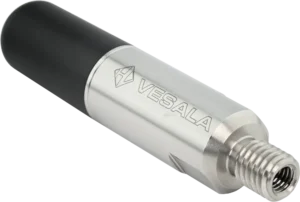
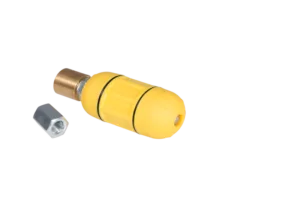
A sonde contains its own transmitter and must use a frequency supported by the locator. Its dimensions, power supply and connection to the pushing element also need checking. Knowing that both devices are described as suitable for sewer work is not enough.
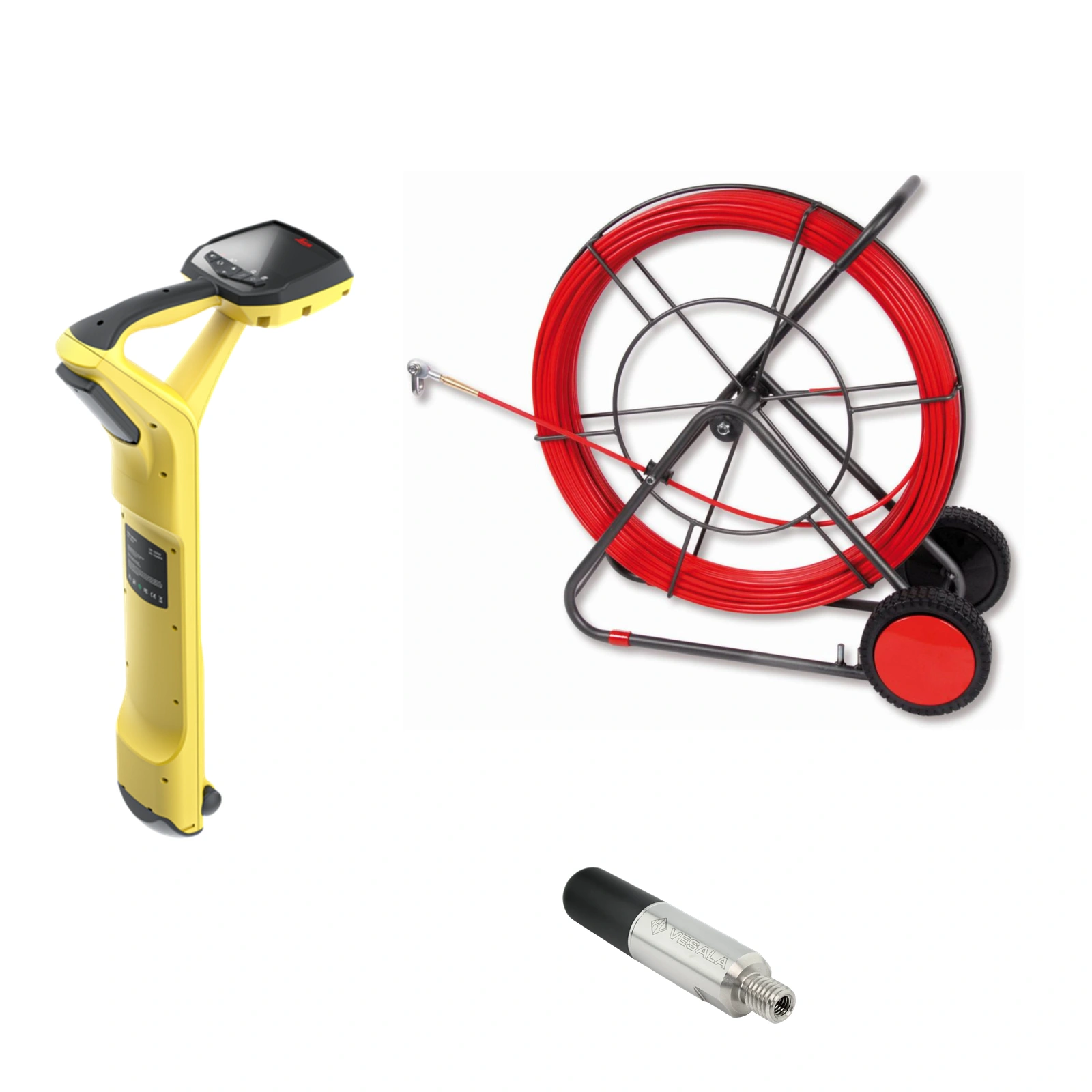
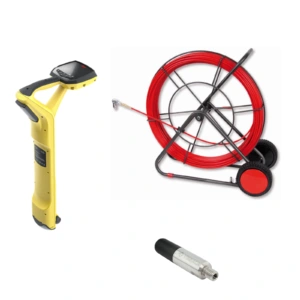
The sewer and drainage tracing kit combines DT100, a Mini sonde and an 80 m, 9 mm rod. It is a separate offer from DT100 + DE100 kits. Always consult the chosen variant’s offer for its exact equipment rather than carrying over the contents of another package.
Fibreglass pushes the sonde: length is not depth
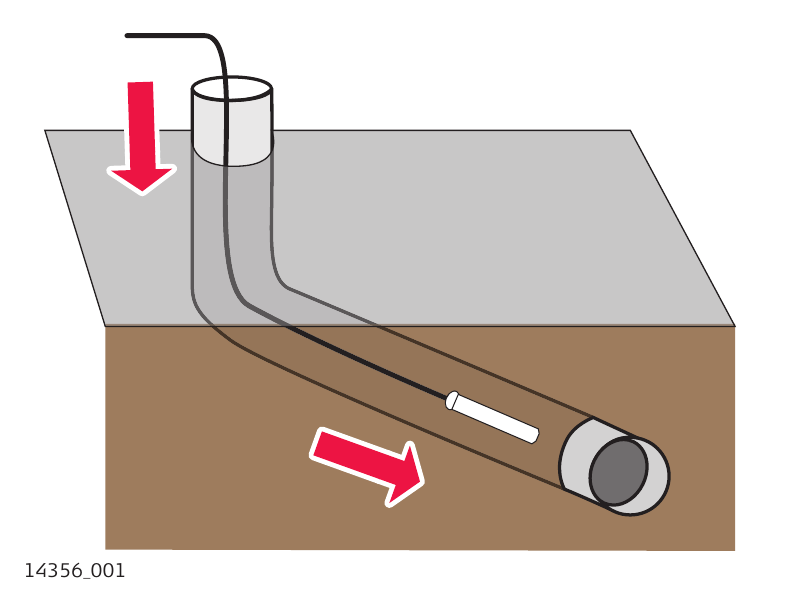
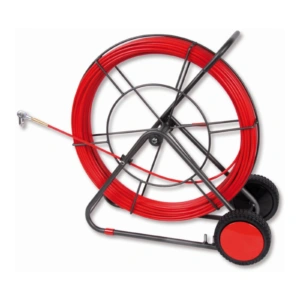
The 9 mm, 80 m fibreglass rod on a reel is a pushing element selected for the task. Its length describes the material available on the reel. It does not specify receiver range, pipe depth or a distance that can always be negotiated.
Check the threaded connection or appropriate adaptor, pipe geometry and the manufacturer’s mechanical limitations. The connector must fit the sonde in use. Numerous bends or an unknown pipe condition cannot be overcome simply by buying a longer rod. Ordinary fibreglass should not be equated with an active TraceRod.
When to consider a tracing rod with a transmitter
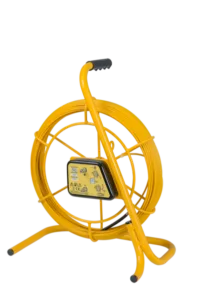
An active tracing rod is constructed to work with a signal. It may help follow the inserted section rather than only locating its tip. Supported functions and working modes depend on the particular product and a compatible transmitter and receiver arrangement.
When comparing TraceRode 50 and 80, separate length from method. Establish the required result, whether the offer includes the necessary connections, and whether the receiver supports the signal-source frequencies. The locator and kit selection guide also discusses transmitter selection.
Recognize the sonde response rather than any signal peak
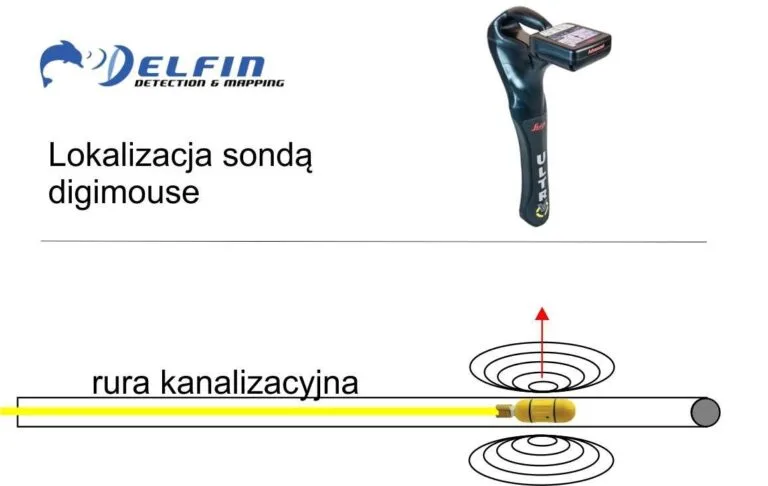
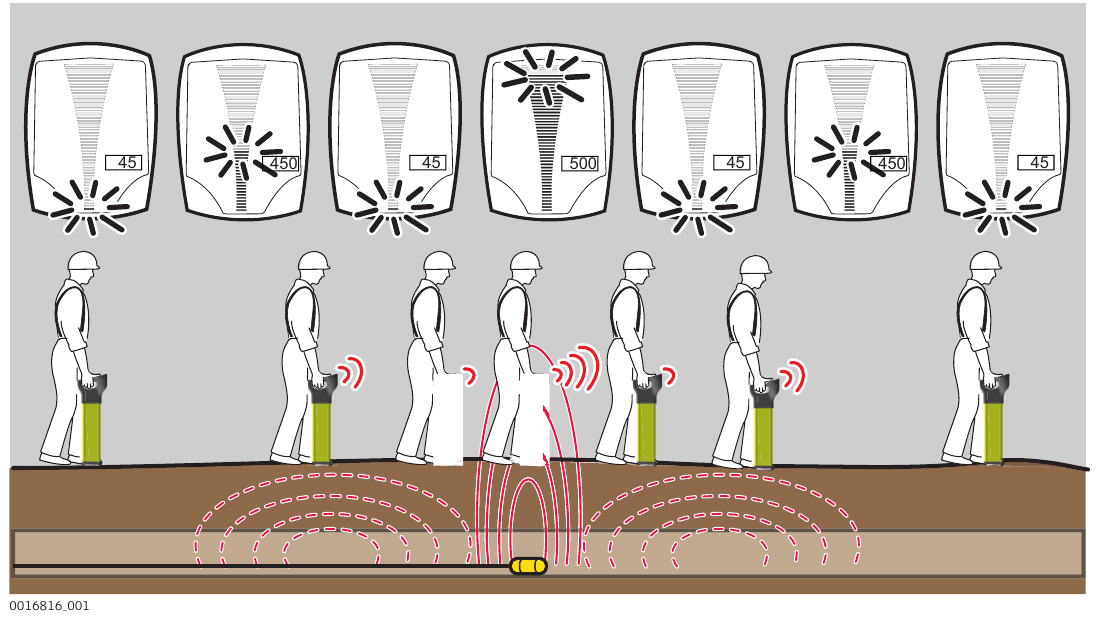
A sonde field has a characteristic response pattern. Receiving a strong signal alone is not enough to locate it confidently. The operator must distinguish the main response from secondary responses and assess repeatability. The manufacturer diagram illustrates this issue; its figures are not a depth scale.
In complex surroundings, sonde position, interference and collector geometry matter. A displayed depth should be considered in the context of the conditions and manual. A large catalogue range for another sonde or receiver does not guarantee the performance of the selected kit.
What if the pipe interior cannot be accessed?
A sonde and an inserted rod need suitable access. If none is available, assess other information sources: records, visible network points, an existing tracer wire or the suitability of GPR. Surface GPR may help when the ground and target properties provide an interpretable response.
Do not replace one uncertainty with another simply by buying more expensive equipment. First identify what limits the task. The guide to locating water pipes with GPR shows how materials and ground affect surface pipe surveys. Sewer investigations also need a separate assessment of conditions.
Build a complete arrangement for the particular pipe
The equipment list should cover the receiver, compatible sonde or tracing rod, pushing element, mechanical connections and appropriate power supplies. A transmitter is needed for certain active methods, but is not automatically required for a sonde with its own transmitter. Check every item when buying a ready-made kit.
Describe access, approximate geometry, material, the locating objective and existing equipment to the supplier. This helps rule out unsuitable accessories before purchase. Sonde location and tracing training can help the team practise recognizing responses and documenting results.
Before choosing equipment
- Is the pipe interior accessible and suitable for the equipment?
- Do I need a point location or a section’s route?
- Which sonde frequencies does my receiver support?
- Do the diameter, thread and adaptor fit the complete arrangement?
- Is the reel an ordinary fibreglass rod or an active tracing rod?
- Does the configuration need a transmitter, and is it included?
- How will I confirm the reading and document limitations?
Questions and answers
Does a Mini sonde require a DE100 transmitter?
A sonde with its own transmitter is located by a compatible receiver without needing a separate transmitter to apply its signal. The transmitter has a different role in tracing a conductive route or suitable active rod. A sewer kit and a DT100 + DE100 kit therefore contain different equipment.
Does an 80 m rod allow detection at 80 m depth?
No. It is the length available on the reel. Location depth depends on the sonde, receiver, geometry and signal conditions. The ability to insert all 80 m also depends on pipe condition, bends and the equipment’s mechanical limitations.
Can ordinary fibreglass be treated as TraceRod?
No. Ordinary fibreglass may push a sonde, whereas an active tracing rod has construction and modes designed to work with a signal. Functions cannot be transferred between products because the reel, colour or length looks similar.
What should be checked when connecting a sonde to a rod?
The connector dimensions, thread or adaptor compatibility, and the manufacturer’s mechanical requirements. Matching product names do not confirm a connection. Also consider the combined sonde and connector dimensions against the pipe’s actual diameter and geometry.
Will a sonde work in every deep collector?
There is no such guarantee. Assess the sonde and receiver combination, transmitter position, surrounding material and interference. For deep work, describe the conditions before selecting equipment instead of relying only on the largest catalogue figure.
Can a sonde alone reconstruct the whole route?
A sonde identifies its own point. Successive correctly located positions help reconstruct a route, but are not a continuous image of the whole section. A suitable active rod and compatible transmitter may be considered for tracing the inserted line, depending on access and the objective.
Why can a sonde produce different signal maxima?
Its field produces main and secondary responses. These must be recognized according to the manual and checked for repeatability. Finding any maximum alone does not confirm the transmitter position or the validity of a depth reading.
Can GPR replace a sonde when the pipe is inaccessible?
It may be an alternative or complement, but needs a separate suitability assessment. Pipe material, size and depth, together with ground properties, affect the image. No internal access does not mean every GPR survey will produce an unambiguous route.
Is the sonde depth the depth of a large collector’s centreline?
Not necessarily. The receiver references the located sonde. If it lies near the bottom of a large pipe, its position differs from the centreline or crown. Documentation should distinguish the transmitter point from the interpreted dimensions of the structure.
Equipment relevant to this guide
Current prices and exact kit contents are shown in the product offers.
Sewer and drainage tracing kit
6 550 €Net price: 5 325 €
Leica DT100 – standalone locator
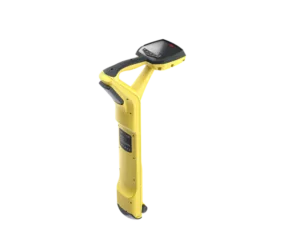
4 900 €Net price: 3 984 €
Mini sonde
550 €Net price: 447 €
9 mm fibreglass sonde rod, 80 m
1 170 €Net price: 951 €
TraceRode 80 tracing rod
1 070 €Net price: 870 €
Midi sonde
520 €Net price: 423 €
Further reading
- Which cable and pipe locator should you choose? Leica DD120, DD130, DD175 or DT100
Choose a locator for the utility and working method. Compare Leica DD100 with DT100, transmitters, sondes and the equipment supplied in kits.